
Treebeard Is Waking Up To AI
There is a particular kind of person you learn to distrust in business: the one who urges everyone to slow down right after he’s gotten out in front. So when the chief executive of one of the world’s leading AI labs publishes an essay asking governments to test his industry’s products, block the ones that fail, and back the whole effort with company money to turn it into law, the reasonable first reaction is to look for the angle.
Hold onto that reaction. Some serious people think the angle is the story, and we’ll get there. But first it’s worth understanding what Dario Amodei actually wrote in Policy on the AI Exponential, published in June 2026, because whatever you decide about the man, he is describing the weather your company is about to operate in. And he is describing it from inside the building where the weather is made.
The speed problem
Amodei begins not with a chart but with a tree.
In The Lord of the Rings, two small hobbits try to convince Treebeard, an ancient and deliberate tree-herding creature, to march to war before the forest is cut down around him. Treebeard is wise. Treebeard is also so slow that it takes him most of a day just to say hello. The hobbits’ problem isn’t that Treebeard is wrong. It’s that he moves at the speed of geology while the chainsaws move at the speed of chainsaws.
That, Amodei argues, is the relationship between artificial intelligence and the institutions meant to govern it. In about four years, AI went from struggling to write a coherent paragraph of code to writing most of the code at the major AI companies. The pattern underneath that leap, that more computing power reliably buys more capability, now has more than a decade of evidence behind it. If it holds for another year or two, Amodei believes we arrive at what he calls Powerful AI, or in his memorable phrase, “a country of geniuses in a datacenter.”
Meanwhile, it can take Congress years to pass a single law. In the gap between an idea entering a committee and a bill leaving it, AI can go from a clever toy to that country of geniuses. The mismatch isn’t anyone’s fault, exactly. Governments hold grave powers, and it’s usually good that they’re slow to use them. But slowness has a cost when the thing you’re slow about is doubling.
If you run a business, you already know this tempo in miniature. The tool your team laughed at eighteen months ago now drafts your contracts, your code, your customer replies. The essay’s whole argument is that this isn’t a series of product updates. It’s a curve. And curves are the thing human beings, and human institutions, are worst at seeing coming.
What changed his mind
Here is the part that makes the essay news rather than another think piece.
For three years, Anthropic’s public position was patience. The company argued that AI firms should be transparent, disclosing their safety testing and reporting serious incidents, but that binding laws should wait until the real risks took clear shape. You don’t write detailed regulations for a danger you can’t yet describe; you’ll end up policing the wrong thing. In 2025 the company backed exactly this kind of disclosure legislation in California, New York, and Illinois.
That position is now retired. In the essay, Amodei says transparency is no longer enough, and the trigger was a specific event: an internal frontier model, tested under a program the company calls Glasswing, turned out to pose genuine cybersecurity risks, the kind that could disrupt financial systems, infrastructure, and national security. The lesson he drew wasn’t only “this particular model is dangerous.” It was proof that AI had become a technology of strategic consequence, the way nuclear weapons once were, and that the next risks (biological, and eventually AI systems acting on their own) are visible on the road ahead.
So the ask changed. Alongside the essay, Anthropic released a legislative proposal and a jobs framework and said it would put substantial financial backing behind them. A funding pledge is not the same as a law. The essay names no dollar figure, and a promise is easy to make. But it is more skin in the game than the genre usually carries, which is reason enough to read the actual proposals closely.
The five things, translated
Amodei organizes the essay around five areas of policy. Stripped of the Washington vocabulary, here is what each one means for someone who signs the front of paychecks.
1. Models get tested like airplanes. This is the centerpiece. Amodei wants frontier AI regulated the way the FAA regulates aircraft: before the most powerful models ship, an independent party tests them, and the government can block or reverse a release that fails. The testing would target four specific dangers:
- cybersecurity,
- biological weapons,
- loss of control of the AI itself, and
- automated research that could accelerate the first three.
Crucially, he scopes it narrowly (only models above a certain size, only those four risks), and the testing could be done by approved private evaluators rather than one government agency, an idea called “regulatory markets.” For most business owners this is not a compliance burden you’ll carry; you don’t build frontier models. It’s more like the FAA standing behind the planes you fly on. You don’t read the inspection reports. You just need the inspections to be real.
2. The economic dial may get stuck. Amodei’s economic argument is the one that should keep operators up at night, and it’s subtler than the usual “robots take the jobs” headline. His claim is that Powerful AI could drive enormous growth and displace human labor faster and more permanently than past technologies, leaving the economy jammed on a setting of hypergrowth and steep inequality at once, hard to unstick. He is emphatic that lasting job loss is bad and worth working hard to prevent, not a future to cheer. He’s also, notably, optimistic about the upside for small operators: he expects individuals to build billion-dollar companies, and points out that teams of a handful of people are already running businesses with hundreds of millions in revenue. The policy menu he floats (wage insurance, incentives to retain workers, retraining grants, and eventually, if displacement is severe, direct income support) is aimed at buying society time to adapt. The takeaway for you isn’t a forecast. It’s a posture: the question worth asking of AI in your business is “what can my existing people now do that they couldn’t before,” not just “who can I cut.”
3. The slow regulators could become the bottleneck. Flip the script from danger to opportunity. In fields like medicine, energy, and materials, Amodei worries less about AI causing harm and more about old regulatory systems being too slow to let AI’s benefits through. A new drug takes seven to eight years to clear the approval pipeline, partly because the system assumes most candidates fail. If AI starts producing better candidates faster, that pipeline becomes a clog, not a filter. He wants agencies like the FDA to write the rules now for accepting AI-driven methods, so good things aren’t stuck waiting in line. If your business touches a regulated industry, the strategic insight is that the constraint may soon shift from “can we invent it” to “can we get it approved.”
4. Your customer data sits inside a live argument. In the section on civil liberties, one item lands directly in the lap of ordinary businesses. Under current law, data that people hand to private companies can be bought and used for bulk government analysis: the “data broker loophole.” Amodei wants it closed, precisely because AI makes mass analysis of that data far more revealing than it used to be. Whatever happens legislatively, the direction of travel is clear: the data you collect and resell is going to draw more scrutiny, not less. He also floats a quietly radical idea, that anyone facing government action should have access to AI as capable as the AI the government is using against them. Fairness, in his framing, becomes a question of who has the better model.
5. Chips are the new oil. Finally, geopolitics. Amodei argues AI isn’t a normal export product to be spread around the world for trade advantage; it’s closer to nuclear capability, something that resets the board. A nation with Powerful AI facing one without it, he writes, could resemble a modern army facing medieval swordsmen. His prescription is a coalition of democracies that share the AI supply chain (chips and the machines that make them) among themselves while denying it to adversaries, and that coordinate their safety rules so companies face one compatible standard instead of fifty. For a business, the practical residue is supply-chain risk: the hardware and infrastructure underneath modern computing now move to the rhythm of national security, and “just buy it from the cheapest source” is becoming a geopolitical bet whether you treat it as one or not.
Now, the angle
Back to that first instinct, the one I asked you to hold.
You are not the only person who noticed that an AI company is lobbying for rules that AI companies are unusually well-equipped to follow. The veteran technologist Steven Sinofsky and others called the proposal a form of regulatory capture: the maneuver where an incumbent welcomes regulation because compliance is a moat that keeps smaller rivals out. Testing regimes cost money and lawyers. The company already has both. Critics also pointed out a conspicuous gap: the proposal talks about models “above a threshold of compute” but never says what the threshold is, which leaves everyone guessing where the rules would actually bite. And a frequently raised objection cuts deeper, that the cure for concentrating dangerous power in a few AI labs cannot be a system designed and run by those same few labs.
These are not cheap shots, and the honest version of this story includes them. Amodei has a partial answer. He writes that AI may become too powerful to entrust fully to either governments or companies, and that companies should therefore be built with more internal checks than usual, pointing to Anthropic’s own governance trust as one attempt. Whether that’s a genuine safeguard or a well-decorated version of “trust us” is exactly the debate worth having, and it’s the one a thoughtful business reader should keep open rather than resolve too quickly.
What this is really asking of you
It would be easy to file this essay under “policy,” which is a folder most business owners never open, and move on. That would be a mistake, not because you need to have an opinion on export controls, but because the document is a fairly clear-eyed map of the terrain your business will cross in the next few years, drawn by someone with an unusually good view of it.
The terrain looks like this. The capability you’re using will keep compounding faster than your instincts expect. The rules around it are about to start moving, slowly at first and then less slowly, and the smartest move is to understand the direction before the speed picks up. The biggest near-term opportunity is using these tools to let your people do more, not to thin them out. The biggest near-term risk on your own books is the data you hold and how you use it. And the ground beneath all of it (the chips, the infrastructure, the supply chain) is quietly becoming a matter of statecraft.
Amodei ends his essay on an image, the way he began it. Treebeard, he writes, is finally waking up: the public has grown alarmed, the politicians are paying attention, the slow institutions are stirring. He means it hopefully. But anyone who runs a business knows the harder truth inside the metaphor: a giant waking up is good news only if you’ve already figured out which way it’s going to step.
More like this

Claude 5 Fable Vibe Check: Anthropic Opens the Door to a Mythos-Class Model
On June 9, 2026, Anthropic did something it had spent two months publicly hesitating to do: it put...

Intelligence Demand Is Infinite
Last quarter our AI bill barely moved. Token usage went up and to the right, the kind of...
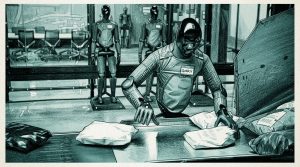
The Livestream That Made 543,000 People Realize We’re Cooked
I was one of the 543,000 people that watched robots work a warehouse shift on a live stream...